The Etymology of Desire
from the latin desiderare, which is composed of two parts

I love words. I love words so much that at 35 big years old I am excavating my Spanish from 12th grade and further complicating things with bi-weekly Portuguese lessons on an app called Preply.
I not so humbly describe myself as “a woman of words,” which really just means: I love to YAP. I love to chat shit, to share philosophy cribbed from podcasts, and I even love to eavesdrop on others as they yap.
Lately, Portuguese lessons have been ripping me a new one. Conjugating verbs, curving my mouth to reveal new sounds, and constantly making mistakes has been necessary, urgent work.
To keep me in the game, I started reading Dr. Kató Lomb's Polyglot: How I Learn Languages. Dr. Lomb famously knew 16 languages, many of which she learned in her 30s and 40s. In it she writes, "Solely in the world of languages is the amateur of value. Well-intentioned sentences full of mistakes can still build bridges between people."
What's most true about language learning is that it stems from our desire to connect. As humans, we crave it. While tools like Google Translate and whatever AI doohickeys get us through quick transactions, learning a language … and truly leaning into the chaos of it … is one of the most romantic things the human brain does. It makes us brave. It makes us choose our words wisely. It can trip us up, but sometimes it's necessary to slow all the way down. There are couples who have been together for years without fluently speaking each other's languages, and yet their connection holds because they work to find their own language. The sweet slippages in between are what bond them. The foundation of good loving is a work of comprehension. On the whole, learning implies a lack of knowing, which also implies room to grow and mature.
We cannot let this fall by the wayside. We need to fail into connection far more than we need to get it right.
In addition to formally learning languages and how to learn languages, I've recently developed the habit of researching the etymology of words. This week's word has been desire.
Desire comes from the Latin desiderare, composed of two parts: the prefix de-, meaning "of" or "from," and sidus, meaning "star" or "constellation." The composition implies a longing or waiting for what the stars will bring, often linked to ancient astrology or navigation. Before this, I'd always equated desire with something corporeal, but I’m moved by this celestial re-imagining.
What we desire is so much more than a yearning. When we let it be, desire is more like a grander connection to the great beyond. We’re all created from stardust and so maybe what we desire is with and within us all along.
Below, I’m including a few of the tabs that opened in my mind as a result. To know me is to know that I am both a woman of words and a woman of well-curated tabs.
1: Emerson Rocha, The Blue Where Yemanjá Reigns (2024)
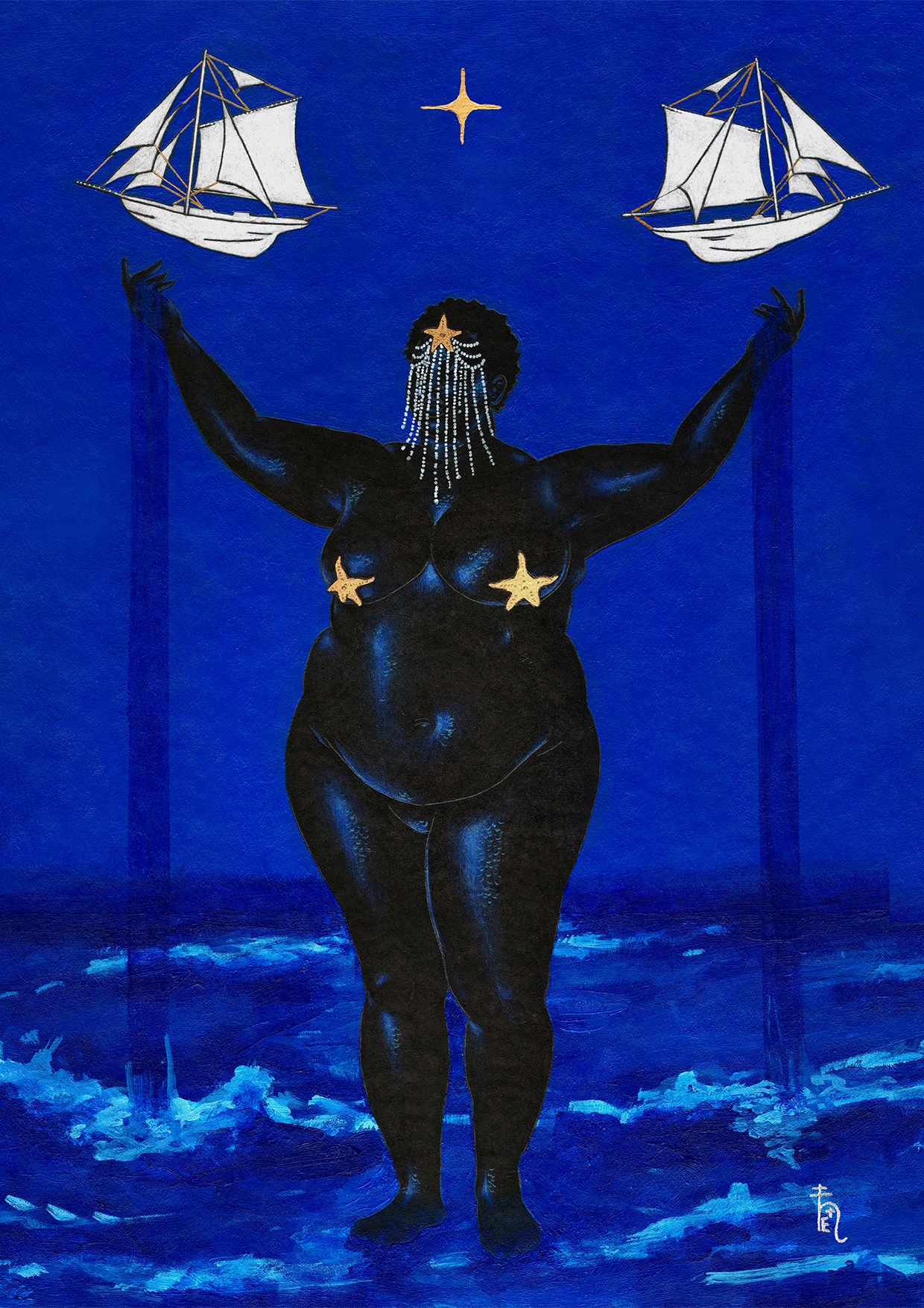
I recently reposted this amazing artwork from Altagracia Alvarado's substack. This work, created by Emerson Rocha and entitled The Blue Where Yemanjá Reigns (2024), immediately re-emerged in my mind when I thought to start this etymology series. Rocha's interpretation of the orixá Yemanjá, covered in stars, struck me. Yemanjá's name is derived from the expression YéYé Omó Ejá: "The Mother whose children are fish." I'd originally wanted to draw a direct connection between this interpretation of Yemanjá and the idea of being born from the stars, but I don't want to speak to what I don't know nearly enough about. What my affection for this image did lead me to, however, is a two-part essay by my beloved T. Lax, Curator at The Museum of Modern Art, New York — Searching for Iemanjá: On the Move in Brazil — a deeper dive on Yemanjá, her lore, and what makes her such a powerful force spiritually and culturally. Go read it and delight.
2: “You Are My Starship” by Norman Connors
The absolute banger "You Are My Starship" by jazz drummer, composer, arranger, and producer Norman Conners is one of those songs where, when it plays, you don’t need to know the words to know the words. I wonder if there's a theory for this—specifically within Black culture. I often feel something like a sonic inheritance in songs by Al Green, Frankie Beverly and Maze, Patti LaBelle, and others. I never stopped to learn the lyrics, but through some osmosis of Blackness they sit in my bones.
Oh, oh, you are my starship
Come take me up tonight and don't be late
Yes, you are my starship
Come take me up tonight and don't be late
And don't you come too soon
3: “Daystar” by Rita Dove from Collected Poems 1974-2004
Rita Dove's "Daystar" remains one of my favorite poems of all time. I first came across it in college in a class with Dr. Kevin Quashie, author of The Sovereignty of Quiet: Beyond Resistance in Black Culture and Black Aliveness, Or A Poetics of Being. Any chance I have to mention him, I do. Without Dr. Quashie's tutelage, I cannot imagine having become a writer. At the time, we were also reading Gwendolyn Brooks's only work of fiction, Maud Martha, another book I absolutely adore and highly recommend.
"Daystar," much like Maud Martha, opens a portal into the subconscious of its protagonist. Beyond its gorgeous prose, Maud Martha's structure always struck me: beyond a few choice moments, Maud Martha is largely muted and doesn't engage in much dialogue. The book's storytelling exists entirely within her mind and purview. Similarly, Dove's protagonist in "Daystar" silently carves out a moment for herself in the middle of her day. She finds mindfulness. She builds a palace. She finds a place to be nothing, pure nothing, in the middle of the day, and in that nothingness she finds both desire and fulfillment.
Daystar
She wanted a little room for thinking;
but she saw diapers steaming on the line,
a doll slumped behind the door.
So she lugged a chair behind the garage
to sit out the children’s naps.
Sometimes there were things to watch –
the pinched armor of a vanished cricket,
a floating maple leaf. Other days
she stared until she was assured
when she closed her eyes
she’d see only her own vivid blood.
She had an hour, at best, before Liza appeared
pouting from the top of the stairs.
And just what was mother doing
out back with the field mice? Why,
building a palace. Later
that night when Thomas rolled over and
lurched into her, she would open her eyes
and think of the place that was hers
for an hour – where
she was nothing,
pure nothing, in the middle of the day.
beautiful words.
there’s something so beautiful about choosing to keep learning language ✨I’m listening to audio books w/ words I love and interesting - keep enjoying!